I knew I wanted to explore cybersex and pornography for my
video but I didn’t have a framing device. When I went back through the Study
Guide I rewatched Generation XXX and something didn’t sit right with me. These
kids were told that what they were doing was wrong, the parents couldn’t
believe their kids were lying to them. I had a gut feeling that the kids were
fine but I needed evidence. I wanted to explore whether you could have a porn
addiction and if you could, was it really that bad?
I had a look around the creative commons website but it was
throwing me out. I didn’t want there to be silence in my video so I just mucked
around on my guitar for 5 minutes. I laid the track and used it as a timer for
the rest of the video. I used Audacity to record my guitar playing, I also just
used my laptop’s inbuilt microphone. I do have an SM-58 Microphone, but since
it was only background audio I didn’t bother setting it up.
I made the Cybersex screen footage by asking a mate to come
online and talk dirty to me. For this I used EzVid as it was simple to record
the screen, I also used EzVid to make the footage of me finding porn.
For the video recording of myself I used Window Live Movie
Maker. If I used EzVid it would have been a tiny video of me. I was going to
pick up a tripod and record myself with my Samsung Galaxy S6, this would have
given me more freedom with location and it may have even been a better quality
recording, but I didn’t pick one up.
For the black backgrounds with white words I used Paint. I’m
sure there are probably better alternatives, at least more professional
alternatives. But I would say Graphic Design is my biggest weakness and it
ended up looking fine.
From the Generation XXX video I moved to some scholarly
sources, like the Waskul and Ben-Ze’ev. These sources looked at the new media
in a mostly positive light. I moved to get some facts from some more scientific
sources. I enjoy getting science facts, it is like rolling a dice, I can assume
that they will back me up but sometimes they don’t, so I have to change the
structure of my work. Luckily for me I couldn’t find any solid evidence that
went against what I wanted to say.
My video was riddled with challenges. During early recording
it turned out I couldn’t speak or read in front of a camera. This came down to
me planning on having a loose and conversational structure like I do for my
podcasts. I spent hours cutting the video and moving it around to look like I
wasn’t an idiot. Failing that I wrote up a script using the best parts of my
research, my early takes and new material. I just read it from the screen (which
I know is bad) and I covered my face as much as I could.
Another problem I had was I didn’t know how to edit videos.
I’ve done them before, but only the most basic videos you could imagine. As I
put footage into Adobe Premiere it became zoomed in to the point of
uselessness. It got to the point that every 2 minutes of work I was doing I had
to watch a 10 minute video to figure out my next obstacle. I believe I went
from absolute beginner to novice over my crash course with editing videos.
(602 words)
References
Ben-Ze’ev, A 2003, Love Online: Emotions on the Internet,
Cambridge University Press, New York.
Heshmat, S 2015, Addiction.
[Electronic Resource] : A Behavioral Economic Perspective, n.p.: Hoboken :
Taylor and Francis, 2015., DEAKIN UNIV LIBRARY's Catalog, EBSCOhost, viewed 2 September
2015.
Struthers, WM 2012, 'Pornography addiction', Salem
Press Encyclopedia of Health.
Waskul, DD 2011, ‘Internet sex: the seductive “freedom to”’,
in Seidman, S and Meeks, C (eds.), Introducing the New Sexuality Studies,
Routledge, Abingdon and New York
I use Facebook to connect socially with friends and lady-friends. I use two Twitteraccounts to advertise my blogs and website. I use my blogs to write about pop culture in a semi-serious way. On reddit.com I post anonymously, this gives me the ability to say what I would normally be afraid to say without any negative repercussions from my peers. I use each different medium to project my self. On Facebook I'll try and rile up my friends, or people on public discussions. On Twitter I am strictly business and maybe a little isolated. My website is my podium, I'll stand atop it and spout my beliefs as if they are the only beliefs to exist. The question I am asking, is who am I? Am I Facebook, Twitter, my website, or am I all of them?
I'm being pulled in every direction except South-East. Image made at http://www.easel.ly/
Above I have shown a Venn diagram on how I depict myself online. I have tried my hardest to keep Facebook separate from the rest of my online personas. Twitter is my go-to for advertising everything I do with my writing and shameless self-promotion. Each circle's size represents their reach. My website persona is interwoven with my Twitters, Soundcloud & About.Me because I am trying to make a brand. 'With the imperative of branding, however, comes the necessity of managing the brand by managing online reputation,' (Smith & Watson, 2014 p79). My Facebook is separate and set to private (temporarily set to public) so that I can socialise with people I know in real life, I can shoot the bull and not worry about how I am making my brand look.
So if I am all of these selves, does that make me schizophrenic?
Schizophrenia is a heterogeneous disorder with a broad range of symptoms and a variable course. It typically afflicts younger individuals, often leading to lifelong disability. The most dramatic aspect of this disease is the periodic episodes of psychotic symptoms (e.g., auditory hallucinations, paranoid delusions) which at times require emergent interventions to protect the individual and others.
(Goldman, Janicak, Marder & Tandon, 2014 p3)
That sounds pretty serious. I am a younger individual, but it doesn't feel like a lifelong disability. If anything it feels like a superpower. I also don't suffer from psychotic symptoms, at least not more than the usual person. Maybe schizophrenia is the wrong disease. Maybe I suffer from split personalities.
The commonest misunderstanding is that the terms multiple personality disorder means that a patient has a ‘split personality’. The ‘split’ relates to a divide from perceived reality rather than what is commonly interpreted to mean a split in actual personality. This is rooted in the literal interpretation of the word multiple personality disorder—devised before a clear understanding or differentiation of the term psychosis was determined.
(Hayes, 2014 p33)
I'm not so sure that I suffer from psychosis. Hayes also mentions that 1% of people can suffer from multiple personality disorder (Hayes, 2014 p33). I don't think I'm in the 1% of people creating multiple identities online. Medical science has failed me, like it has many others. Another theory could be that each persona is not an entire identity, but a smaller piece of the puzzle.
The Patriot
The scoundrel
Literary writer, Jorge Luis Borges, wrote about identity in the 1960's. He wrote an essay titled Borges and I, in it he played with the idea that the writer and the person were completely different people. He finished it off with 'I do not know which of us has written this page' (Borges, 1964 p283). Through being a writer Borges was an early adopter of the online self. He understood the disconnect between the self he was publishing to the world and the self that he saw himself as. 'The production of a self through representation is a more complex affair than a conscious performance as commonly argued in new media studies' (Poletti & Rak, 2014 p5). Borges and I (Me and Borges, not the essay referenced) can both relate with Poletti and Rak's claim. We aren't necessarily creating new personas to present, we are presenting different aspects of ourselves, even when we try to project a false self a bit of our true self will shine through.
I'll admit that my Twitter is my advertising station. I only use it to scam traffic my way. But even then a lot of my self comes through in my advertising. Even though I was hyping myself up, (something I was new to at the time) my interests and personality came through.
'If we are the sum total of our data, and if our data is not only indicative of a self but also symbolic of what we possess, then our existence becomes precarious' (Poletti & Rak, 2014 p11). I think Poletti and Rak have hit the nail on the head. Our online selves are part of us. What we put online is our data, if you can manage to put it all together you still won't be able to have a complete profile. Even with every piece of ourselves laid bare, you will still be missing one part, 'human beings are worth cherishing because of their rich, distinctive, individual natures' (Lanier in Gauntlett, 2013). When you have all the profiles, all the handles, all the online avatars of a person reigned in and made complete, that's when you have your true self. These social websites are pieces of the puzzle, but they don't demonstrate the individual natures of a human being.
To sum it up, we aren't all suffering from a mental illness. We, as humans, have adapted. 'In the expanding array of virtual environments, identities become increasingly manipulable' (Smith & Watson, 2014 p82). We have figured out how to make the most out of a situation. '(W)e can't allow our very selves to be reduced to a template' (Gauntlett, 2013 p196). If we were only using one social media site, we may very well be able to mold ourselves into a template, but Web 2.0 means that if you were only using one networking site, you are missing out on a lot.
Sources
Borges, L 1964, 'Borges and I' in Labyrinths, Penguin, London
Gauntlett, David 2013, Making is Connecting, e-book, accessed 5 August 2015, <http://deakin.eblib.com.au/patron/FullRecord.aspx?p=1184117>. Goldman, M, Janicak, P, Marder, S, & Tandon, R 2014, Schizophrenia : Recent Advances In Diagnosis And Treatment, n.p.: New York : Springer, [2014], DEAKIN UNIV LIBRARY's Catalog, EBSCOhost, viewed 9 August 2015. Hayes, C 2014, 'Multiple personality disorder: an introduction for HCAs', British Journal of Healthcare Assistants, vol. 8, no. 1, pp. 29-33. Poletti, A and Rak, J 2014, ‘Introduction: digital dialogues’, in Poletti, A and Rak, J, Identity Technologies: Constructing the Self Online, The University of Wisconsin Press, Madison, pp. 3-11.
Smith, S and Watson, J 2014, ‘Virtually Me: A Toolbox about Online SelfPresentation’,
in Poletti, A and Rak, J, Identity Technologies: Constructing
the Self Online, The University of Wisconsin Press, Madison, pp. 70-95
How common is multimedia journalism in the media I consume?
I am a student in his early-twenties, I live, breathe and
eat electricity. What’s a newspaper? Newspapers are those dry magazines that
used to be delivered daily so my parents could read their horoscopes and do the
crosswords. They did, and still do, provide a recount of what happened the day
before. If something happened on the 20th of May you could read
about it on the 21st of May. Without an exceptional reason I would
never read a newspaper. I would absolutely never pay for a newspaper, even with
an exceptional reason.
I would subscribe to The Daily Bugle
How about television? Kids these days love television,
right? When I was a little fat kid I had the television guide memorised. The
television guide was actually in the newspaper, I’m not sure if it still is.
The cartoons finished at 5.30pm on Channel 2, and then I would switch to the
Channel 10 news to fill the void before The Simpsons started. But it isn’t the
90s anymore, why would I watch television? Everyone and his dog are trying to
sell something to me and my dog. I live in the future, I’m not going to wait
around until 5.30pm to find out something that happened at 4pm, why would I
want to be an hour and a half behind the latest stories as well as sit through
10 minutes of advertisements?
I’m an iBoy. If something happens in Bulgaria I know about
it instantly. As people we are given the gift of Government-level surveillance.
The Australian Government wants to censor information; they don’t want a
particular story getting out to the citizens? Have fun with that, because I
read it on Reddit 3 hours ago. Multimedia journalism isn’t just widespread in
the media I consume; the media I consume IS multimedia journalism. Traditional
journalists get the same raw information that I get, I’m not special; I am one
of billions.
Can multimedia journalism be structured in a linear fashion
using multiple elements? It can, but why would it limit itself? If you read a
multimedia story you are given the privilege to find out opposing information
and judge it for yourself, you can watch video evidence of the story, you can see
hundreds of pictures; each speaking a thousand words. A linear story? You would
have to skip every hyperlink, not follow videos to find similar information, and
not look up related articles. There are no doubt many linear journalistic
stories on the Internet, but how is that special? It isn’t. It is an underuse
of the technologies available. If people wanted linear storytelling then go
watch the television or go read a newspaper.
Hollywoodisation is 'the metaphor developed of America sharing its culture with the rest of the world' (Wasser, 1995). This has become prominent in cinema globally, but does it occur in other forms of media?
I am going to argue that Hollywoodisation has become more prevalent, or even epitomised, in videogames.
For this blog I will be drawing examples from a number of video games that I believe are related to Hollywoodisation.
Let us start from the beginning. Donkey Kong Arcade introduced the 'convention that spectacle be subsumed to the demands of the narrative' (Klein, 2004 p 366) to video games way back in 1981. The action of avoiding barrels, fire and death pits made sense within the narrative of climbing up a construction site to punch a monkey.
More recently the Kingdom Hearts series 'has first-rate cinematography, exquisite costumes and settings, internationally known stars, and even special effects' (Klein, 2004, p 375), all elements that are used when describing Hollywood films. The costumes that look amazing in the games would look silly in the context of a film. The settings of the game would cost too much money to be reasonable in making a film. It has voice actors such as Haley Joel Osment and Mandy Moore in the game. None of the game is filmed, the whole game is special effects. The first Kingdom Hearts game came out in 2002 and it had 'Hollywood production values, a tight story and smart script' (Wu cited in Klein, 2004 p 376) and more. This is only one example of a video game being more Hollywood than Hollywood but there are manymoreexamplesIcoulddrawfrom.
Movies will always have their entertainment value and for the foreseeable future will appeal to a mass audience, but there is no entertainment more engaging than immersing yourself in a cinematic game. I don't believe movies should be based on video games (Super Mario Bros, Tomb Raider) as movies are, quite frankly, an inferior product. Video games can build from film, they are not set by the same constraints as films (runtime, actors). Video games can be above 'the Hollywood standard: stronger scripts, better acting, improved mise-en-scene, and advanced sound and image technology' (Klein, 2004 p 374).
I love movies, don't get me wrong, but if I was asked what were my favourite cinematic experiences none of my answers would be from a film. I'm interested in hearing your thoughts on Hollywoodisation and video games, let me know what you think in the comments.
References
Klein, Christina 2004, ‘Martial arts and globalisation of US and Asian film industries’, Comparative America Studies, vol. 2, no. 3, pp. 360-384. NINTENDO 1981, Donkey Kong, Arcade, Japan:Nintendo
SQUARE 2002, Kingdom Hearts, DVD Playstation 2, Japan:Square. Wasser, F 1995, ‘Is Hollywood America? The Trans-nationalization of the American Film Industry’ Critical Studies in Mass Communication, Vol. 12, pp.423-437.
Also, I'm not sure if I have any dedicated followers on here, but if you exist, thank you for taking the time to read my blogs. Sadly, this will be the last blog I will be posting here. If you want to read more from me check out my other blog Culture Burst where I will try and post something new every week or check out my YouTube channel where I will start posting some more quality content soon. And follow me on Twitter
Like, Comment, Subscribe, Upvote, Thumb, Retweet, Share. This is the currency used in the Specular Economy.
But what is the Specular Economy?
'A two-way projection on to the screen and the circulation of an interation with those images and texts into the wider world.(...) a specular economy whose foundations are derived from the much longer tradition of celebrity culture and whose repercussions relate to an emerging comfortability with a society of surveillance,' (Marshall, 2010 p 498.)
Sites such as YouTube and Reddit utilise the notion that people want to be known by strangers. With the globalisation of media it is entirely possible that anyone can be a celebrity.
I wish I was beyond fishing for Internet Celebritification.
I am going to give a story of how I was robbed of some sweet, sweet Specular currency.
Recently, I was driving with my girlfriend. We drove past this little possum chilling in the gutter. My girlfriend got out of the car to shoo it off the road and the little guy climber up her leg and onto her shoulder. I was laughing, safe in the loving coccoon of the car, taking photos. We ended up getting the possum to get into a tree. I took some decent shots and proceeded to upload them to Reddit. It was a modest post, it got a little bit of attention, I got 216 Internet points for it.
But if you google the title of my post you will see it on 9gag, DailyFailCenter, LolShelf and a couple of others. The thing that annoys me most though, is the 9gag watermark on most of the pictures. And also the huge success it has had on other sites, with my title. How can this girl be everyone's girlfriend?
But alas, t'is the nature of the specular economy 'The images are not just for our own personal consumption and they are not just conveyed images' (Marshall, 2010 p 500). So if people want to steal my intellectual property I can't be too annoyed. I put it on the Internet to begin with.
At least KarmaDecay exists and tells the world that it was originally my photo.
You have to listen to this song while reading this blog.
Inspiration for this blog post comes from a video by Feminist Frequency. The video "Damsel in Distress - Tropes vs Women in Video Games" explain how women are portrayed as objects in video games from a feminist point of view. I am going to refute her points, despite it being covered manytimesbefore. Anita Sarkeesian used the original Donkey Kong Arcade game as an example, she went somewhat into depth on the spin-off series 'Super Mario' but she missed many important aspects of both series.
I will be using Stuart Hall's reading strategies to help organise my refutes to the claim that video games are sexist towards women. Hall's three reading strategies are the 'preferred reading', the 'negotiated reading' and the 'oppositional reading' (Hall 1973). These reading strategies can be used singularly or be used together. I am going to be discussing Stuart Hall's three reading strategies in regards to gender firstly in the Donkey Kong Country series and then the Super Mario series.
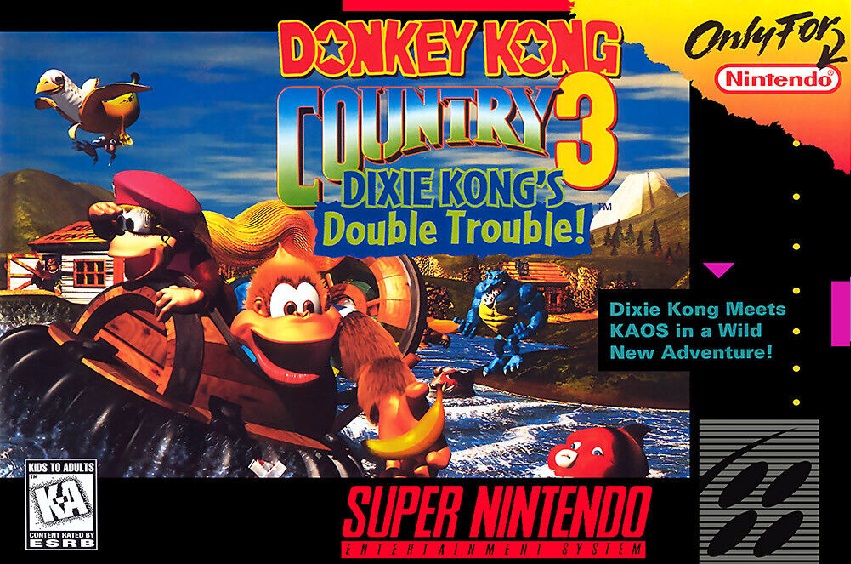
In the original game all of DK's (Leader of the bunch) bananas are stolen by King K.Rool, the baddest evil lizard king in Donkey Kong Country. This spurs DK to leave his tree house and quest to get his bananas back and get revenge. The series of games follows the same formula but with each game the main protagonist of the game is rotated. In DKC2 the game follows Diddy Kong and his girlfriend Dixie Kong chasing after King K.Rool to rescue Donkey Kong. The third game has Dixie as the main protagonist working with Kiddie Kong to rescue Donkey Kong (he's the first member of the DK Crew) and Diddy Kong from King K.Rool.
My negotiated reading is that the Donkey Kong Country games are completely devoid of any sexism. There is no female damsel in distress throughout the series. The games even subvert this by having the original main protagonists become dudes in distress in later games. Dixie is introduced as Diddy Kong's girlfriend and by her second game she is the main protagonist. Even in the second game she was more useful than Diddy Kong, she could hover. In a game where the biggest threat is falling to a grisly death a few seconds extended air time really helps immensely. Donkey Kong has a girlfriend as well, instead of getting captured by Bowsers and Ganons she runs her own business. Sure she is pretty for a monkey, but so is DK and a pretty monkey like him should not feel sexist for having an attractive monkey partner.
An oppositional reading, or the Anita Sarkeesian reading, is that this game does not exist. Despite using the original Donkey Kong Arcade game as an example of the Damsel in Distress 'trope' and the Mario games that spiraled from it, Sarkeesian never mentioned the DKC franchise. The reason for this is that it opposes her belief that games are sexist towards women.
Anita Sarkeesian used Princess Peach as one of her main examples of sexism in video games. Her view was that Peach has only been playable in two games. Those two games were Super Mario Bros 2 and Super Princess Peach. She does acknowledge that she is playable in other games, but they don't count because reasons.
In SMB2, Princess Peach outshines the three other playable characters (Mario, Luigi & Mushroom Head) for the same reason Dixie does in DKC, she can float.
In Super Princess Peach, Peach admittedly gets by on her mood-swings. She burns people with her rage and drowns people with her tears and she switches between rage and sadness within a second. Sarkeesis may have a point that this is an unfair depiction of a woman. Though, to keep in line with Hall's method of reading I will justify it.
See the picture above? Notice those Heart-shaped hearts in the top right? That is her health bar. How many times has Mario had a health bar in a sidescrolling platformer? Notice the size of Peach? She is huge and she did not have to eat any mushrooms. She has four available super powers to use at her will. If you could control her in other Mario platformers the game would have no challenge, this girl is a beast. Sarkeesian mentioned two instances in this game that made it disempowering towards women. I mentioned seven instances that empower women and I haven't played the game since it came out.
I mentioned earlier that Sarkeesian said that Peach was only playable in two games. I should specify that Sarkeesian only meant sidescrolling games in the main series and not in any of the spin-offs. Even though Super Princess Peach is a spin-off and Super Mario Bros 2's plot happened in a dream.
I would argue that the spinoffs do count. I can see how Sarkeesian would not mention them as it is an example of gender equality, something Sarkeesis is fighting for. Peach is playable in most of the Mario Sports titles (too many to list here), a capable fighter in Super Smash Bros Melee & Brawl, a swashbuckling adventurer in the platformer Yoshi Island DS and the platformer/RPG Super Paper Mario, a party member in Super Mario RPG, a staple in the widely successful Mario Kart & Party series and she is about to be a playable character in the upcoming game Super Mario 3D World.
By being playable in all those games I believe she is undermining her role as a princess. She has the most important job in the Mushroom Kingdom, she does not have time to be out jumping on platforms, she needs to be governing her kingdom. By putting her life in peril she is putting the needs of her own over the needs of her kingdom. If anything this should be considered harmful to women as it shows that a successful woman in a position of authority was selected only on her position of birth and gender, not of her qualifications for the job. Maybe if she started to spend more time getting her people to build anti-Bowser cannons instead of them getting captured all the time Peach would have more time to govern instead of getting kidnapped.
Realistically Peach should have paid some Toads to go rescue Mario and Luigi in Super Princess Peach instead of risking her kingdom. I can understand that she may feel bad about constantly being rescued by Mario and she may want to return the favour but it really is just bad leadership.
If I were going to make a Princess Peach game it would be an RTS. Peach would play the tactician and defend her kingdom from enemies seen throughout the Super Mario games. It makes too much sense to not make it. It is empowering women. It shows her being a princess without neglecting her duties and the men saving her are doing it under her command not because they didn't have any sinks to fix.
The Super Mario series can just as easily be read as sexist towards men as it can sexist towards women. In the main series of games it is shown that every man is dastardly and evil, whereas women are a symbol of peace and hope. Bowser is bad because he kidnaps royalty and kills Mario and Luigi with fireballs, hammers and simply by touching them. Everyone seen in the Mushroom Kingdom is a soldier enlisted by Bowser and they too can kill with a touch. Mario and Luigi say they are plumbers but they have been on princess saving duty since the 80s. They are definitely the two most highly trained soldiers in Peach's army and they have gotten so used to the constant bloodshed that now they smile while they are stomping the enemy.
None of the enemies are depicted as female. There is a female Goomba shown in one game and she was a protagonist. There is Birdo, the dinosaur boss with a bow in Super Mario Bros 2 but she was born a male. Birdo has figured out the only way to survive in this horrific dystopia is to pretend to be a woman. Throughout the series men are shown to be nothing but vile soldiers, with a single track mind, risking life and limb to save the most important person in the Mushroom Kingdom. The main protagonist in the series die from being touched by an enemy, thus showing how powerless a man is. The best way to survive in the game is through going after typically femenine items such as flowers, jewellery and costumes. This enforces that the feminine way is superior to the masculine way.
I could go on, it's fun. This is what Hall was communicating, texts can be manipulated through critical thinking to suit any agenda one may have. Anita Sarkeesis used examples that supported her cause but was not open to discuss any examples she may have missed that opposed her cause. I do not believe that there are a bunch of faceless men building these games trying to oppress any gender. They try to make a game that sells and they will stick to safe stories and mechanics that have worked before.
If you believe I have been unfair in my examples or have overlooked something, please let me know in the comments and I will discuss this further with you.
References
Hall, S. 1973, Encoding and Decoding in the Television Discourse. Birmingham [England: Centre for Cultural Studies, University of Birmingham, 1973. 507-17
Raessens, J 2005, ‘Computer games as participatory media culture’, Handbook of computer game studies 2005, MIT Press, Cambridge, Mass, pp. 373-388
Bibliography
RARE, 1994, Donkey Kong Country, Super Nintendo Cartridge, Super Nintendo Entertainment System, USA:Nintendo
RARE, 1995, Donkey Kong Country 2: Diddy's Kong Quest, Super Nintendo Cartridge, Super Nintendo Entertainment System, USA:Nintendo
RARE, 1996, Donkey Kong Country 3: Dixie Kong's Double Trouble!, Super Nintendo Cartridge, Super Nintendo Entertainment System, USA:Nintendo
Hi there BlogFans. Today I am going to take you on an adventure to a dimension you may not know about. That's correct! You are following me into the Blogosphere!
The Blogosphere (http://securetechusa.com/)
By now you probably know what a blog is. It is a virtual place online where people will pretend to be more important than they are and give their ideas on a topic that other people have already done. I know this because I am a blogger. You know this because you are reading my blog.
I blog because I want to be a Prof3ssio4l Wr1t3r one day but a quick search shows that as of October 2011 there were roughly 18.7 million blog writers. This is insane, surely I, a special snowflake, don't have the same dreams and aspirations of 18.7 million other people. That's nearly an Australia's worth of people.
We will have to delve into the Blogosphere to find out who else is blogging.
The Web-log-o-sphere (or Blogosphere for short) is made up of blogs linking to other blogs linking to news articles with all the linking back and forth between news sites and blogs around the world it creates the blogosphere (Poell, 2009 p 244).
New media scholars believe that the Internet extends the public sphere (Hurgen in Poell, 2009 p 239) and through extension of the public sphere it increases public debate (Poell, 2009 p 241).
So to put it elegantly, some people are offering their sides of an argument and comparing it with other blogger's arguments. Whether this be over political ideals, complaining about work or the problems with the latest X-Men movie, blogs are definitely invoking a discussion.
Some other bloggers use blogs as a platform to start their career as a journalist. Though bloggers may not have the ethical training afforded to paid journalists (Benjamin 2011 p 280).
So there you have it, the Blogosphere is made up workers, writers, "journos" and people with political agendas. 18 million of them in March. I'm too scared to see the current statistics of the sea of people I have to contend with.
References
Benjamin in Noor Al-Deen, H; Hendricks, J 2011, Social Media : Usage and Impact, e-book, accessed 10 September 2013, <http://deakin.eblib.com.au.ezproxy-f.deakin.edu.au/patron/FullRecord.aspx?p=795614>.
Poell in van den Boomen, M; Lammes, S; Lehmann, A; Raessens, J; Schäfer, M 2009, Digital Material : Tracing New Media in Everyday Life and Technology, e-book, accessed 10 September 2013, <http://deakin.eblib.com.au.ezproxy-f.deakin.edu.au/patron/FullRecord.aspx?p=474227>.


.png)


