Inspiration for this blog post comes from a video by Feminist Frequency. The video "Damsel in Distress - Tropes vs Women in Video Games" explain how women are portrayed as objects in video games from a feminist point of view. I am going to refute her points, despite it being covered many times before.
Anita Sarkeesian used the original Donkey Kong Arcade game as an example, she went somewhat into depth on the spin-off series 'Super Mario' but she missed many important aspects of both series.
I will be using Stuart Hall's reading strategies to help organise my refutes to the claim that video games are sexist towards women. Hall's three reading strategies are the 'preferred reading', the 'negotiated reading' and the 'oppositional reading' (Hall 1973). These reading strategies can be used singularly or be used together.
I am going to be discussing Stuart Hall's three reading strategies in regards to gender firstly in the Donkey Kong Country series and then the Super Mario series.
In the original game all of DK's (Leader of the bunch) bananas are stolen by King K.Rool, the baddest evil lizard king in Donkey Kong Country. This spurs DK to leave his tree house and quest to get his bananas back and get revenge. The series of games follows the same formula but with each game the main protagonist of the game is rotated. In DKC2 the game follows Diddy Kong and his girlfriend Dixie Kong chasing after King K.Rool to rescue Donkey Kong. The third game has Dixie as the main protagonist working with Kiddie Kong to rescue Donkey Kong (he's the first member of the DK Crew) and Diddy Kong from King K.Rool.
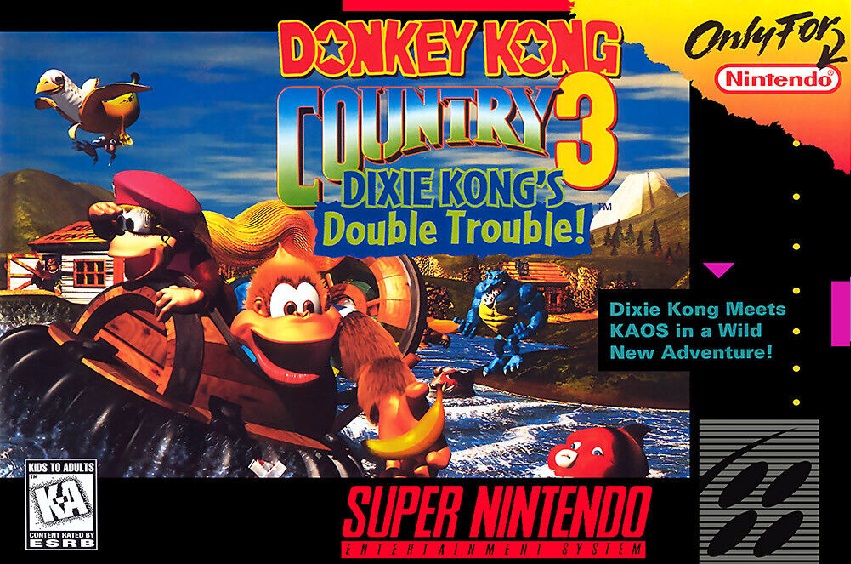
My negotiated reading is that the Donkey Kong Country games are completely devoid of any sexism. There is no female damsel in distress throughout the series. The games even subvert this by having the original main protagonists become dudes in distress in later games. Dixie is introduced as Diddy Kong's girlfriend and by her second game she is the main protagonist. Even in the second game she was more useful than Diddy Kong, she could hover. In a game where the biggest threat is falling to a grisly death a few seconds extended air time really helps immensely. Donkey Kong has a girlfriend as well, instead of getting captured by Bowsers and Ganons she runs her own business. Sure she is pretty for a monkey, but so is DK and a pretty monkey like him should not feel sexist for having an attractive monkey partner.
An oppositional reading, or the Anita Sarkeesian reading, is that this game does not exist. Despite using the original Donkey Kong Arcade game as an example of the Damsel in Distress 'trope' and the Mario games that spiraled from it, Sarkeesian never mentioned the DKC franchise. The reason for this is that it opposes her belief that games are sexist towards women.
.png)
Anita Sarkeesian used Princess Peach as one of her main examples of sexism in video games. Her view was that Peach has only been playable in two games. Those two games were Super Mario Bros 2 and Super Princess Peach. She does acknowledge that she is playable in other games, but they don't count because reasons.
In SMB2, Princess Peach outshines the three other playable characters (Mario, Luigi & Mushroom Head) for the same reason Dixie does in DKC, she can float.
In Super Princess Peach, Peach admittedly gets by on her mood-swings. She burns people with her rage and drowns people with her tears and she switches between rage and sadness within a second. Sarkeesis may have a point that this is an unfair depiction of a woman. Though, to keep in line with Hall's method of reading I will justify it.

See the picture above? Notice those Heart-shaped hearts in the top right? That is her health bar. How many times has Mario had a health bar in a sidescrolling platformer? Notice the size of Peach? She is huge and she did not have to eat any mushrooms. She has four available super powers to use at her will. If you could control her in other Mario platformers the game would have no challenge, this girl is a beast. Sarkeesian mentioned two instances in this game that made it disempowering towards women. I mentioned seven instances that empower women and I haven't played the game since it came out.
I mentioned earlier that Sarkeesian said that Peach was only playable in two games. I should specify that Sarkeesian only meant sidescrolling games in the main series and not in any of the spin-offs. Even though Super Princess Peach is a spin-off and Super Mario Bros 2's plot happened in a dream.
I would argue that the spinoffs do count. I can see how Sarkeesian would not mention them as it is an example of gender equality, something Sarkeesis is fighting for. Peach is playable in most of the Mario Sports titles (too many to list here), a capable fighter in Super Smash Bros Melee & Brawl, a swashbuckling adventurer in the platformer Yoshi Island DS and the platformer/RPG Super Paper Mario, a party member in Super Mario RPG, a staple in the widely successful Mario Kart & Party series and she is about to be a playable character in the upcoming game Super Mario 3D World.
By being playable in all those games I believe she is undermining her role as a princess. She has the most important job in the Mushroom Kingdom, she does not have time to be out jumping on platforms, she needs to be governing her kingdom. By putting her life in peril she is putting the needs of her own over the needs of her kingdom. If anything this should be considered harmful to women as it shows that a successful woman in a position of authority was selected only on her position of birth and gender, not of her qualifications for the job. Maybe if she started to spend more time getting her people to build anti-Bowser cannons instead of them getting captured all the time Peach would have more time to govern instead of getting kidnapped.
Realistically Peach should have paid some Toads to go rescue Mario and Luigi in Super Princess Peach instead of risking her kingdom. I can understand that she may feel bad about constantly being rescued by Mario and she may want to return the favour but it really is just bad leadership.
If I were going to make a Princess Peach game it would be an RTS. Peach would play the tactician and defend her kingdom from enemies seen throughout the Super Mario games. It makes too much sense to not make it. It is empowering women. It shows her being a princess without neglecting her duties and the men saving her are doing it under her command not because they didn't have any sinks to fix.

The Super Mario series can just as easily be read as sexist towards men as it can sexist towards women. In the main series of games it is shown that every man is dastardly and evil, whereas women are a symbol of peace and hope. Bowser is bad because he kidnaps royalty and kills Mario and Luigi with fireballs, hammers and simply by touching them. Everyone seen in the Mushroom Kingdom is a soldier enlisted by Bowser and they too can kill with a touch. Mario and Luigi say they are plumbers but they have been on princess saving duty since the 80s. They are definitely the two most highly trained soldiers in Peach's army and they have gotten so used to the constant bloodshed that now they smile while they are stomping the enemy.

None of the enemies are depicted as female. There is a female Goomba shown in one game and she was a protagonist. There is Birdo, the dinosaur boss with a bow in Super Mario Bros 2 but she was born a male. Birdo has figured out the only way to survive in this horrific dystopia is to pretend to be a woman. Throughout the series men are shown to be nothing but vile soldiers, with a single track mind, risking life and limb to save the most important person in the Mushroom Kingdom. The main protagonist in the series die from being touched by an enemy, thus showing how powerless a man is. The best way to survive in the game is through going after typically femenine items such as flowers, jewellery and costumes. This enforces that the feminine way is superior to the masculine way.
I could go on, it's fun. This is what Hall was communicating, texts can be manipulated through critical thinking to suit any agenda one may have. Anita Sarkeesis used examples that supported her cause but was not open to discuss any examples she may have missed that opposed her cause. I do not believe that there are a bunch of faceless men building these games trying to oppress any gender. They try to make a game that sells and they will stick to safe stories and mechanics that have worked before.
If you believe I have been unfair in my examples or have overlooked something, please let me know in the comments and I will discuss this further with you.
References
Hall, S. 1973, Encoding and Decoding in the Television Discourse. Birmingham [England: Centre for Cultural Studies, University of Birmingham, 1973. 507-17
Raessens, J 2005, ‘Computer games as participatory media culture’, Handbook of computer game studies 2005, MIT Press, Cambridge, Mass, pp. 373-388
Bibliography
RARE, 1994, Donkey Kong Country, Super Nintendo Cartridge, Super Nintendo Entertainment System, USA:Nintendo
RARE, 1995, Donkey Kong Country 2: Diddy's Kong Quest, Super Nintendo Cartridge, Super Nintendo Entertainment System, USA:Nintendo
RARE, 1996, Donkey Kong Country 3: Dixie Kong's Double Trouble!, Super Nintendo Cartridge, Super Nintendo Entertainment System, USA:Nintendo
Sarkeesian, A 2012, 'Damsels in Distress: Tropes Vs Women Part One', Feminist Frequency, <http://www.youtube.com/watch?v=X6p5AZp7r_Q&feature=c4-overview-vl&list=PLn4ob_5_ttEaA_vc8F3fjzE62esf9yP61>
Sarkeesian, A 2013, 'Damsels in Distress: Tropes Vs Women Part Two', Feminist Frequency,<http://www.youtube.com/watch?v=toa_vH6xGqs&list=PLn4ob_5_ttEaA_vc8F3fjzE62esf9yP61>
Sarkeesian, A 2013, 'Damsels in Distress: Tropes Vs Women Part Three', Feminist Frequency,<http://www.youtube.com/watch?v=LjImnqH_KwM&list=PLn4ob_5_ttEaA_vc8F3fjzE62esf9yP61>

Great choice of using Donkey Kong as the foundation of your blog post, seldom does a blog post have any personal interest straying from the conventional work themed topics that often arises. The use of the Aquatic Ambiance to begin the blog post immediately creates an eerie tinge of seriousness to your blog which is much welcomed and creates a different dynamic toward blogging. I quite enjoyed reading about how the game is devoid of any sexism, and the theory that this game technically does not exist (lol?). I had never really thought about the topic prior to reading this, but I couldn’t agree more. Many games especially in the era of the 90’s had sexism prevalent in its main themes, however Donkey Kong separates itself entirely. Great blog post, it was enjoyable.
ReplyDeleteHi Kris,
ReplyDeleteGood post. I really like the interactivity of it with the Donkey Kong music. I think it was good how you stated exactly what you were going to discuss and went straight on to define Hall's methods before unpacking them in relation to Donkey Kong. I like how you personalised some parts as if directly talking to the reader, as I felt like it involved me in the post more. I think DK is a great example of a non sexist game and I agree with your negotiated reading, I think how you highlighted that Anna interpreted DK in an oppositional reading is really true and I hadnt even thought about it that way before reading your post. Thanks!
I found Feminist Frequency’s video extremely interesting when we watched it in the tutorial and was completely sold by their lecture on female portrayal in video games. As a result I really like that in your post you have contested this as well as providing evidence to support your argument as well as show what was purposely not mentioned. Your use of media with both the photos and the aquatic ambience music were great and really set the tone of the piece. Donkey Kong country proved to be an excellent example as you pointed out, because it was both ‘devoid of any sexism’ and subverts the damsel in distress trope by instead having a lead male captured. You have also made great use of references to support your writing, well done.
ReplyDeleteHey Kris,
ReplyDeleteI absolutely loved this blog. You had me from the intro with getting me to read the blog whilst listening to the Donkey Kong music. I would also like to note that that I really like how you have kept the theme of Donkey for your blogs, pure genius!
Your post has some great points and Donkey Kong games work really well for this topic as a non sexist game. I found it really interesting about the theory of how his game doesn’t exist.
As I am also a gamer, this post brought up nostalgia and your discussion about games being sexist is so true. Do game designers do this because they believe females won’t play?
Thanks for the read,
Nathan